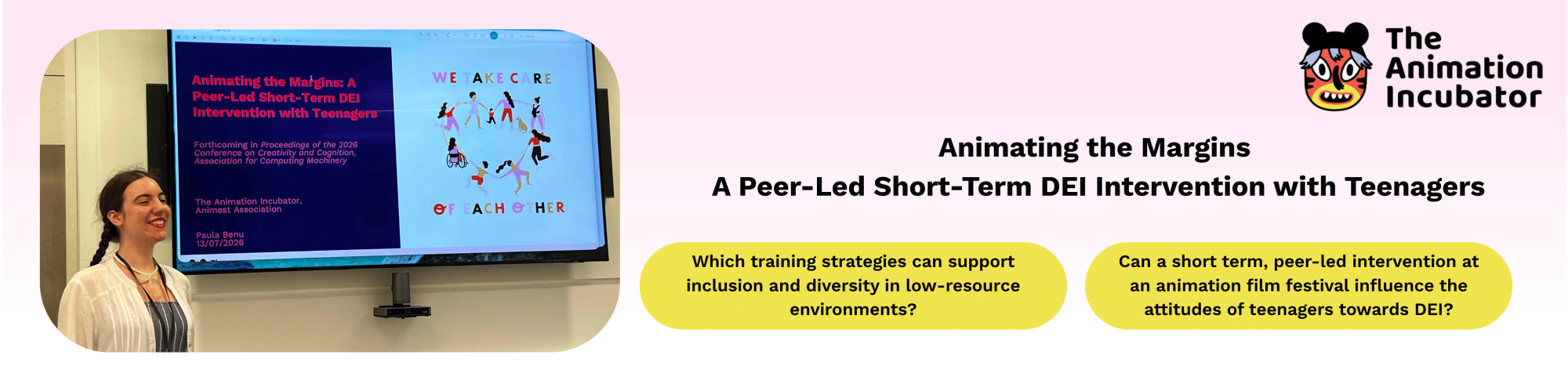
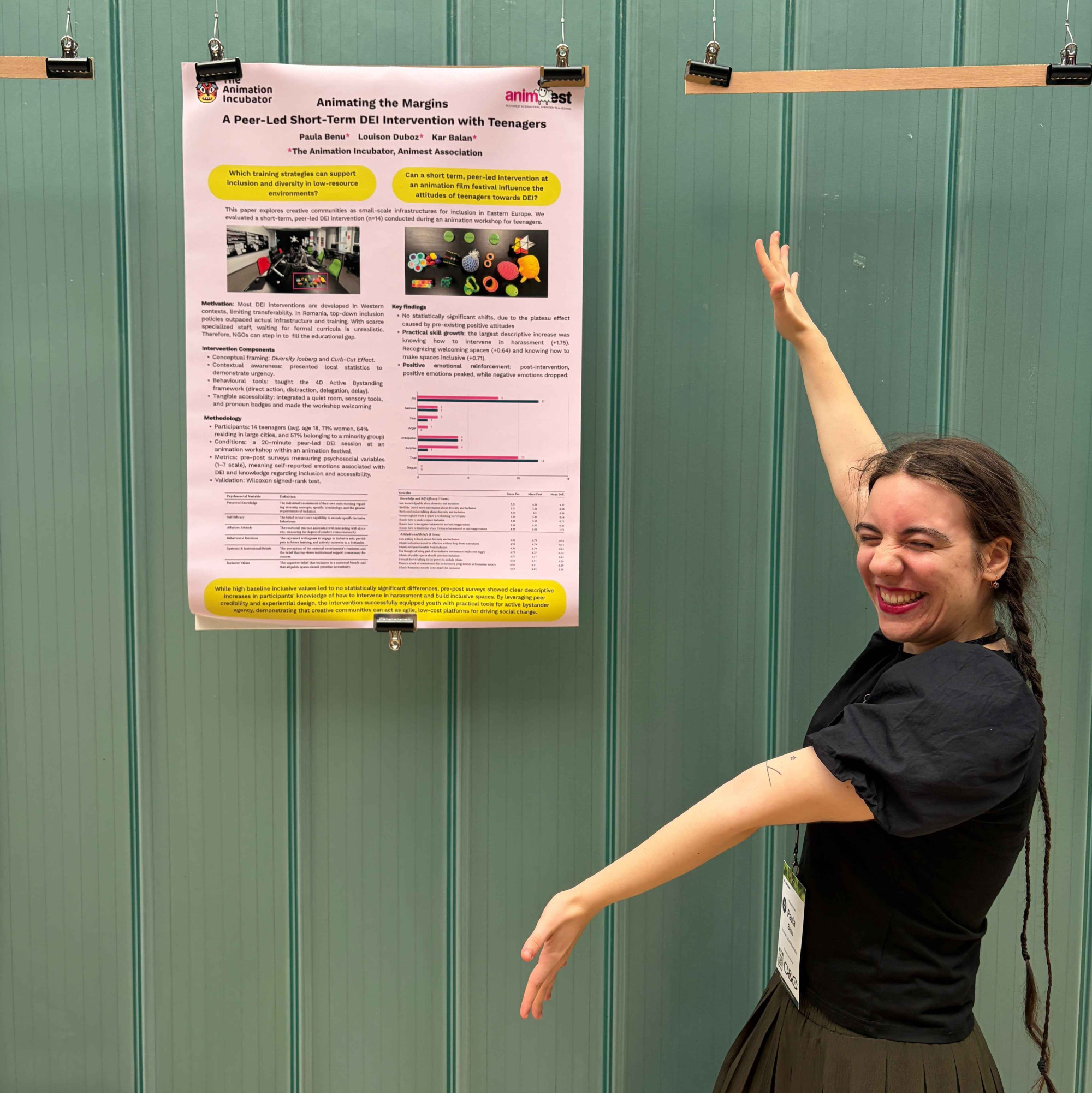
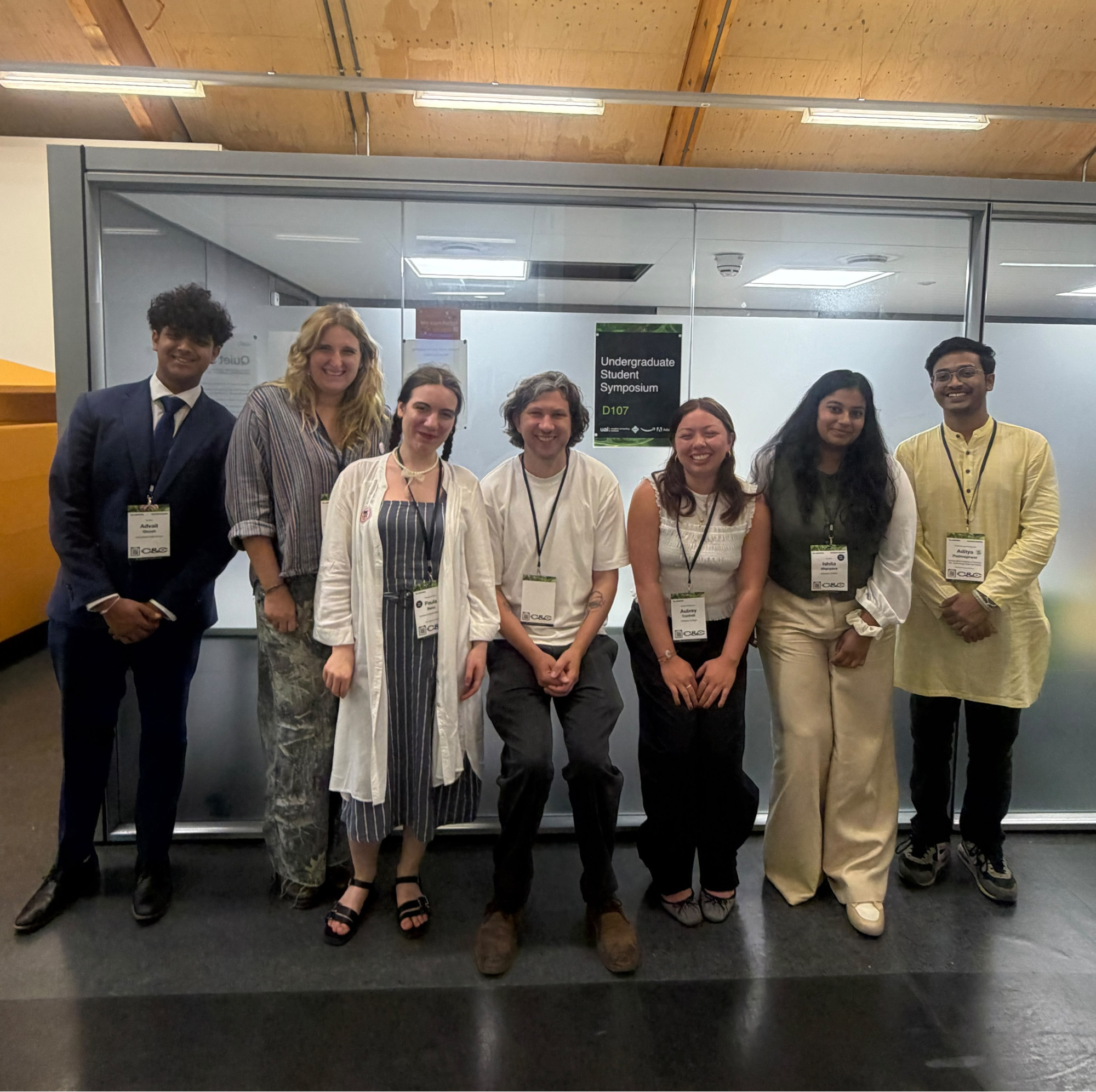
As part of our mission to create safe and empowering spaces for young creatives, our team conducted a case study during the Animest International Animation Film Festival. Our research explores how creative communities can act as agile, small-scale infrastructures for social inclusion, particularly in Eastern European contexts where institutional support is often limited.
We evaluated a short-term, peer-led intervention designed to strengthen Diversity, Equity, and Inclusion literacy and active bystander agency among teenagers. By combining peer-led education with experiential accessibility measures, such as a quiet room, sensory tools (fidget toys), and pronoun badges, we aimed to help young people move from passive support for inclusion to active agency.
The results showed that our teenage participants already held highly inclusive values, but the intervention successfully equipped them with practical tools to take action, highlighting a strong increase in their knowledge of how to intervene when witnessing harassment and how to make spaces more welcoming.
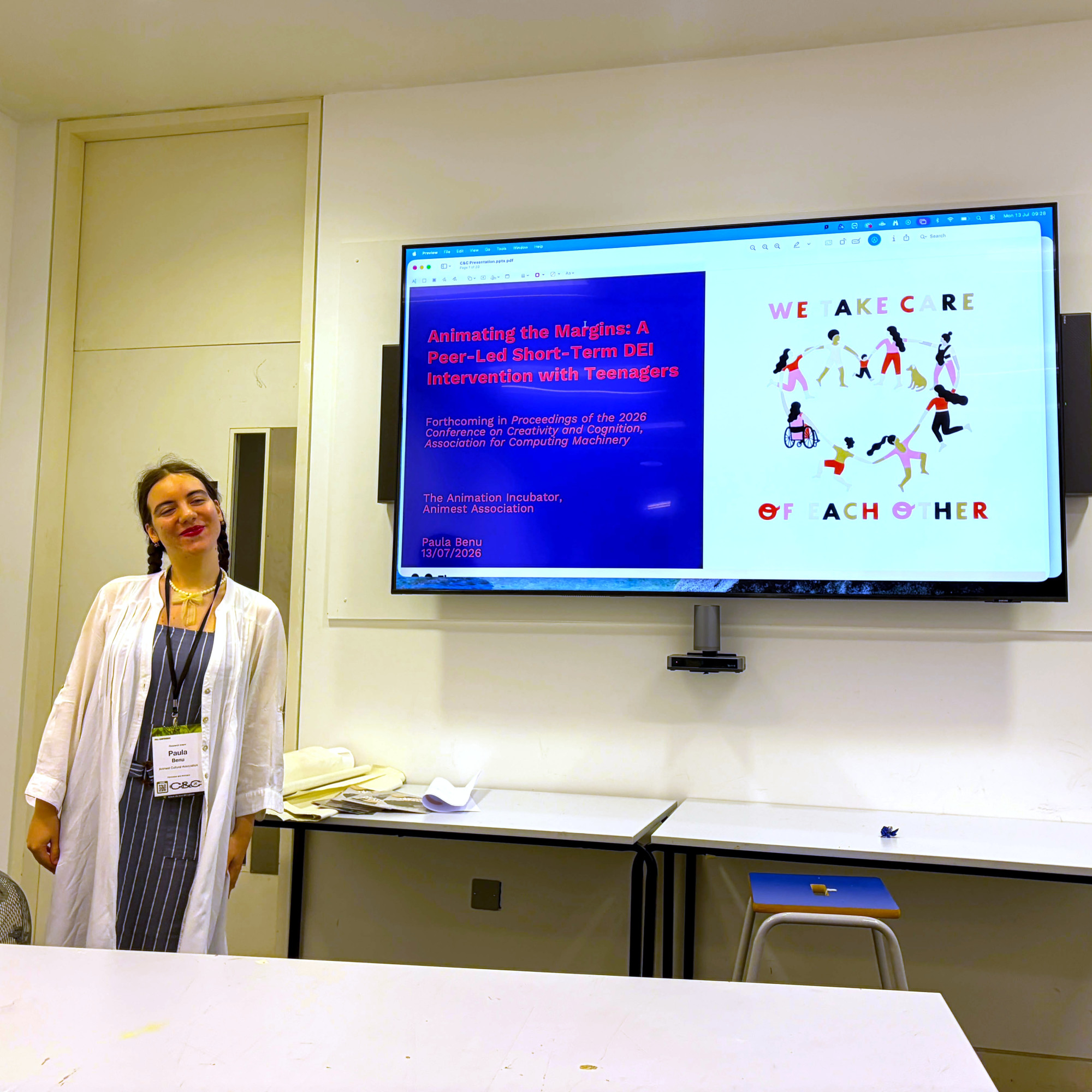
We are proud that our research paper was accepted and presented at the prestigious ACM 2026 Creativity and Cognition Conference in London, officially published in the Association for Computing Machinery proceedings.
You can read the full research paper below, or you can access it on the official ACM website.
Citation: Paula Benu, Louison Duboz, and Kar Balan. 2026. Animating the Margins: A Peer-Led Short-Term DEI Intervention with Teenagers. In Proceedings of the 2026 Conference on Creativity and Cognition (C&C '26). Association for Computing Machinery, New York, NY, USA, 96–102. https://doi.org/10.1145/3803784.3804481
This project was funded by the European Union. Views and opinions expressed are however those of the authors only and do not necessarily reflect those of the European Union or the European Education and Culture Executive Agency (EACEA). Neither the European Union nor EACEA can be held responsible for them.